
5kW or 5.75kW Inverter? Your EV Tariff Decides - Pinergy, Bord Gáis, Energia & SSE Compared
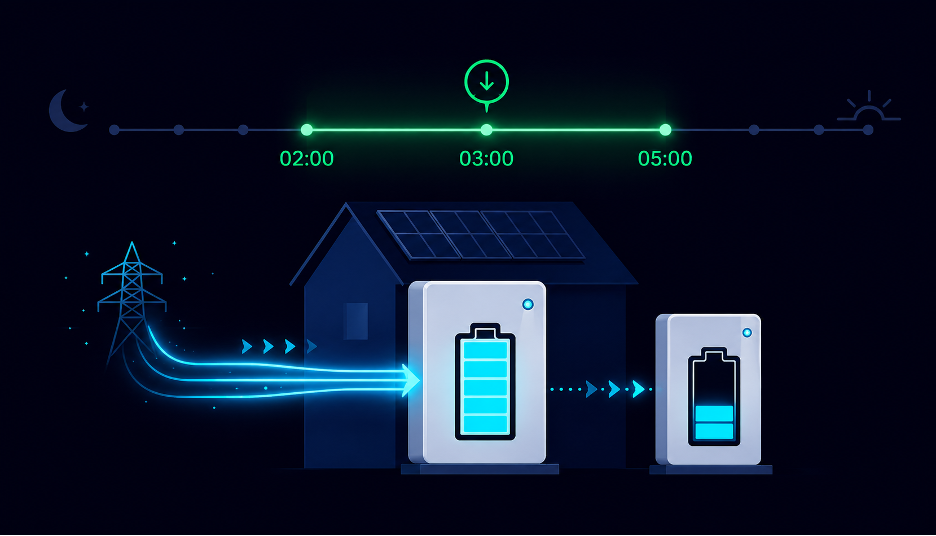
The case for a 5.75kW inverter over a 5kW gets dramatically stronger or weaker depending on your EV tariff. The shorter the cheap-rate window, the more your inverter size matters. Here's the four-tariff matrix.
The Question We Keep Getting Asked
"Is it worth paying for a 5.75kW inverter when a standard 5kW unit will pass the export-limit conversation just fine?" It's the most common upgrade question I hear from Irish homeowners specifying a hybrid system in 2026.
Until recently, the honest answer was: a little, but only if your panels and battery are already at the larger size. That answer is now wrong — but only on certain EV tariffs. The structural shape of your supplier's cheap-rate window completely rewrites the maths.
Below, I put a SAJ H2 5.75kW and a Solis S6 5.0kW side-by-side on an identical Irish home, then run the same model across four different EV tariffs: Pinergy, Bord Gáis, Energia and SSE Airtricity. The savings range from €98 to €356 per yeardepending entirely on which one you're on.
Why the Cheap-Rate Window Length Is Everything
Lithium-iron-phosphate batteries don't accept their full rated charge power for the entire cycle. As they approach 100%, they enter the constant-voltage (CV) phase and the inverter automatically tapers the current. After accounting for round-trip conversion losses and that taper, the realistic average battery charge rate for each inverter is:
Solis 5.0kW:~4.3 kW average charge
SAJ 5.75kW:~5.0 kW average charge
Now apply that to a 15kWh battery. With a 3-hour cheap window, the Solis adds ~13 kWh — falling about 2 kWh short of full. The SAJ fits exactly 15 kWh in. Stretch the window to 4 hours and both inverters fill the battery comfortably. Stretch it to 6 hours and the bigger inverter has nothing to prove.
"On a 3-hour window, every minute counts. On a 6-hour window, the inverter could be napping for half of it. Tariff first, inverter second."
The Four Tariffs in One Glance
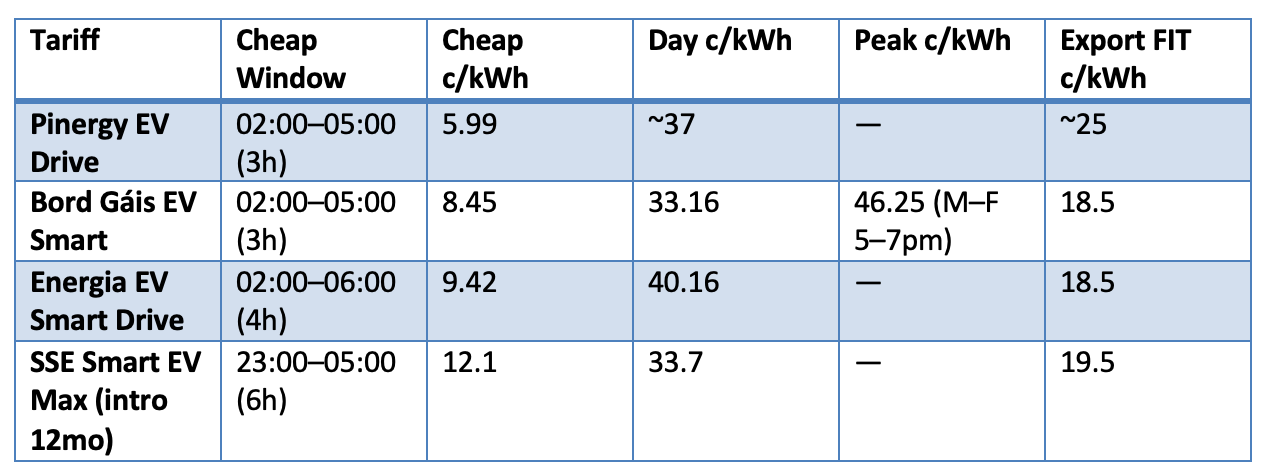
Headline rates as of April 2026. Exact rates vary by urban/rural and intro-discount status — always check the supplier's price plan page before signing.
The Four Savings Mechanisms
Across every tariff, the bigger inverter delivers value through the same four mechanisms. The amount each contributes is what changes:
Battery shortfall avoidance — only matters if the cheap window is too short to fill the battery on the smaller inverter (i.e. 3-hour windows).
·Recovered solar clipping— summer-day generation above 5kW that the Solis caps and discards.
·Evening peak coverage — short bursts above 5kW (cooker + kettle + immersion) covered from battery instead of imported at day rate.
·Daytime spike catching — short, sharp domestic spikes self-consumed by the bigger inverter that would otherwise leak onto the meter.
The Matrix
Here's the full breakdown — same 6kWp / 15kWh / 4,500 kWh-per-year Irish home, only the tariff and the inverter change.
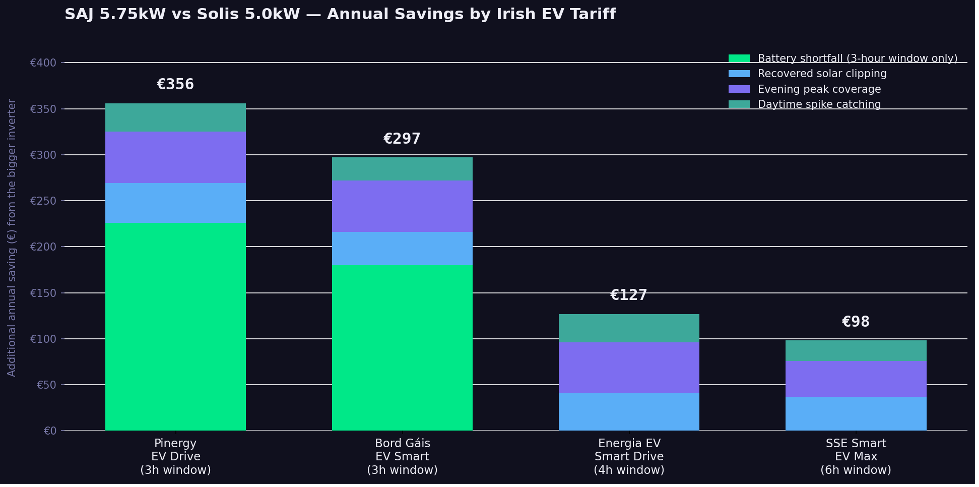
Stacked bar chart comparing annual SAJ-vs-Solis savings across four Irish EV tariffs: Pinergy €356, Bord Gáis €297, Energia €127, SSE €98. Battery shortfall savings are €226/€180/€0/€0.
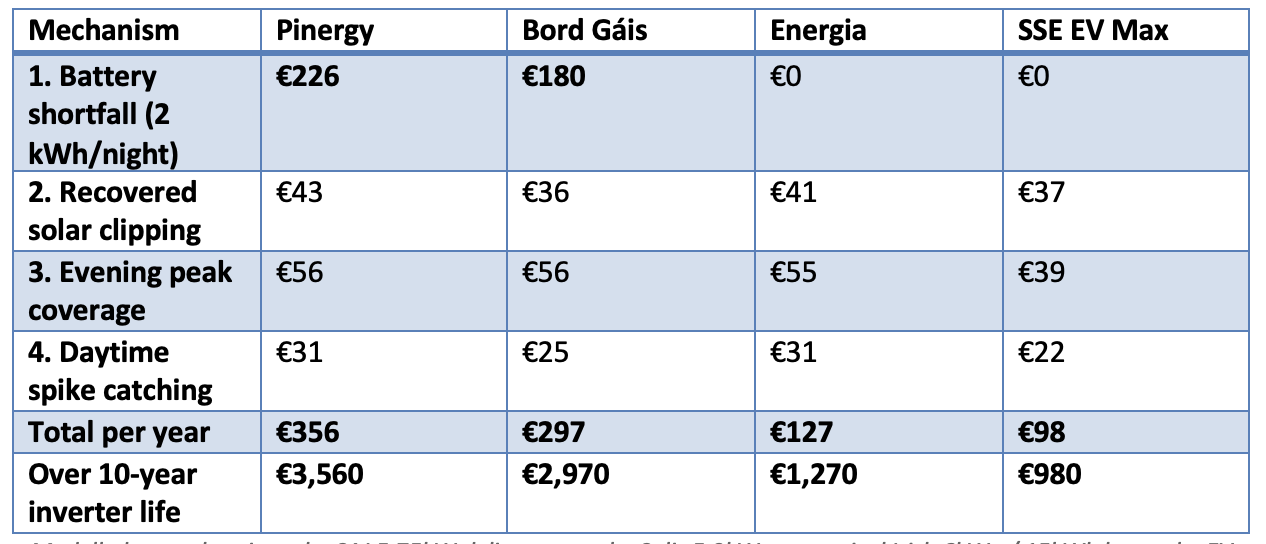
Modelled annual savings the SAJ 5.75kW delivers over the Solis 5.0kW on a typical Irish 6kWp / 15kWh home, by EV tariff.
Pinergy EV Drive - €356/year
The big winner for the bigger inverter, for two reasons stacked on top of each other. First, the cheap window is only 3 hours — tight enough that the Solis 5.0kW physically can't fill a 15kWh battery before 05:00. Second, the gap between cheap (5.99c) and standard (37c) is huge — every kWh you miss costs you 31c the next day. That single mechanism is worth €226/year on its own.
On Pinergy, the SAJ pays for the price difference inside two years.
Bord Gáis EV Smart - €297/year
Same 3-hour window as Pinergy, so the battery shortfall mechanism still applies — €180/year there because the cheap–standard gap (8.45c vs 33.16c) is narrower. Bord Gáis also has a peak band (46.25c, weekday 5–7pm) which means the SAJ's evening coverage is even more valuable than on the flat-rate tariffs. It just gets diluted into the average.
Still solidly worth the upgrade — €2,970 over a 10-year inverter life.
Energia EV Smart Drive - €127/year
Energia's 4-hour window (02:00–06:00) is the inflection point. With 4 hours, even the Solis at 4.3kW average has time to fill the 15kWh battery (4.3 × 4 = 17.2 kWh of headroom, of which only 15 needs to land). The dominant battery shortfall mechanism collapses to zero.
What's left — clipping, peaks, spikes — still adds up to €127/year. That's not nothing, but it's no longer a slam-dunk. On Energia, the inverter sizing call is genuinely close.
SSE Smart EV Max - €98/year
Six hours of cheap rate (23:00–05:00) is more than either inverter can usefully eat. The Solis idles for the second half of the window once the battery is full. There's no shortfall to avoid. The remaining €98 of SAJ-over-Solis savings comes purely from clipping recovery, evening coverage and daytime spike catching — and the cheap–standard gap (12.1c vs 33.7c during the intro period) is the smallest of the four tariffs.
If you're on Smart EV Max, the inverter sizing decision genuinely doesn't move the needle much. Spend the difference on a slightly bigger battery instead.
IRISH HOMEOWNER TAKEAWAY
Pick your tariff before you finalise your inverter size. On a 3-hour cheap window (Pinergy, Bord Gáis), the 5.75kW inverter is a no-brainer — it pays for itself in 1–2 years. On a 4-hour window (Energia), it's a close call. On a 6-hour window (SSE), the bigger inverter saves comparatively little.
What If You Add an EV?
Everything above assumes no EV charging in the cheap window. As soon as you add a 7kW home charger — the whole reason most people choose these tariffs — the situation shifts further in favour of the larger inverter on the 3-hour windows. The EV pulls its own current directly from the grid at the cheap rate, which is fine, but the household will also still want to fill the battery in the same three hours. Any inverter that can't keep up forces compromise on one or the other.
I'll publish a follow-up modelling the dual-load case (15kWh battery + 7kW EV charger sharing the cheap window) — and how the SSE 6-hour window transforms from "inverter-size doesn't matter" to "the bigger inverter is suddenly back in play" — in the next post.
Honest Caveats
Tariff rates change frequently. Figures here are the published headline rates as of April 2026 — check the supplier's price plan page before signing anything.
SSE Smart EV Max numbers use the 12-month introductory pricing. After the intro period the day rate revert to ~48.2c, which actually increases the SAJ's annual benefit (the cheap-vs-standard gap widens). Year-2 savings on SSE land near €135/year.
Bord Gáis has urban vs rural pricing variants. The figures here use the urban rates; rural is broadly similar within a few cents.
·The 4.3kW vs 5.0kW average charge rates are modelled values, not measured ones. Real-world taper depends on the specific battery brand, BMS firmware and ambient temperature. Conservative central estimates used.
·Solar clipping varies year-to-year with weather. ~140 kWh/year is a typical Irish year — bright years see more, dull years see less.
This is a comparison of inverter rating, not inverter brand. Both SAJ and Solis make competent units; the 5.75kW SAJ here is representative of any 5.5–6kW hybrid in the same tier.
Verdict - Match the Inverter to the Tariff
The standard answer to "5kW or 5.75kW?" used to be a shrug. That was correct on flat tariffs and still correct on long cheap-rate windows — but on Pinergy and Bord Gáis it's a clear loss. The shorter the cheap window, the more aggressively the bigger inverter pays back.
If you've already chosen Pinergy EV Drive or Bord Gáis EV Smart, specify the 5.75kW inverter — €3,000+ over the system's life is a serious return on a few hundred euro of upfront cost. If you're on Energia or SSE EV Max, it's a closer call, and the price difference is better spent elsewhere (more panels, bigger battery).
On a 3-hour window, the 750 watts isn't a footnote. It's the whole point.